Indexed Universal Life insurance may be one of the most argued-about financial products on the internet.
Spend a few minutes on social media and you’ll find someone telling you an IUL is the secret to tax-free wealth. Someone else will tell you to “be your own bank.” Keep scrolling and you’ll find someone insisting no informed person should ever own one.
They’re all arguing about the same thing: whether an IUL is good or bad.
I think that’s the wrong question. After years of designing these policies for clients in Middle Tennessee and across the country, the question I keep coming back to is a different one.
Who is an IUL actually for?
The answer has almost nothing to do with anyone’s opinion of the product. It has everything to do with what the policy is being asked to accomplish, whether the person is an appropriate candidate, how the policy will be funded, and how it is ultimately designed.
Because there isn’t one way to build an IUL. And there isn’t one reason to own one. Let me open the hood and show you what actually matters.
First, an IUL Is Life Insurance
That sounds obvious, but it’s an important place to start.
An IUL is permanent life insurance. It provides a death benefit and has the potential to accumulate cash value. Interest credited to the policy may be linked to the performance of an external market index, subject to the terms of the contract.
You aren’t investing directly in the stock market. And an IUL isn’t simply an investment account with an insurance wrapper.
Age, health, insurability, the amount of death benefit needed, available cash flow, time horizon, liquidity needs, and the purpose of the policy all matter. So before comparing caps, participation rates, or illustrated values, I want to answer a more fundamental question: what job are we asking this policy to do?
There Isn’t One Ideal IUL Buyer
One person may primarily need permanent life insurance protection.
Another may need life insurance but also value the opportunity to accumulate cash value over a long period of time.
Someone else may be interested in potentially accessing accumulated cash value later in life through properly managed policy loans and withdrawals.
A business owner or a family with substantial legacy needs may have an entirely different objective.
All of them could potentially be appropriate IUL clients. But they shouldn’t necessarily own the same IUL. That’s an important distinction. The question isn’t simply whether someone “qualifies” as a candidate. We also need to determine what kind of design fits the objective.
Protection First or Accumulation First?
This is where I think many IUL conversations go off track.
Suppose someone needs permanent life insurance but doesn’t have the cash flow or assets to aggressively fund a policy for accumulation. Does that automatically mean an IUL is inappropriate?
No. It may only mean that trying to force that person into an accumulation-focused design is inappropriate.
A protection-focused design begins with the death benefit the person needs and a premium they can reasonably sustain. Cash value may develop over time, but maximizing accumulation isn’t the primary job of the policy.
An accumulation-focused design starts differently. Now funding capacity becomes especially important. We need to consider liquidity, time horizon, death-benefit structure, policy expenses, future access to cash value, available riders, and how the policy may perform under less favorable assumptions.
Same type of insurance. Different objective. Different design.
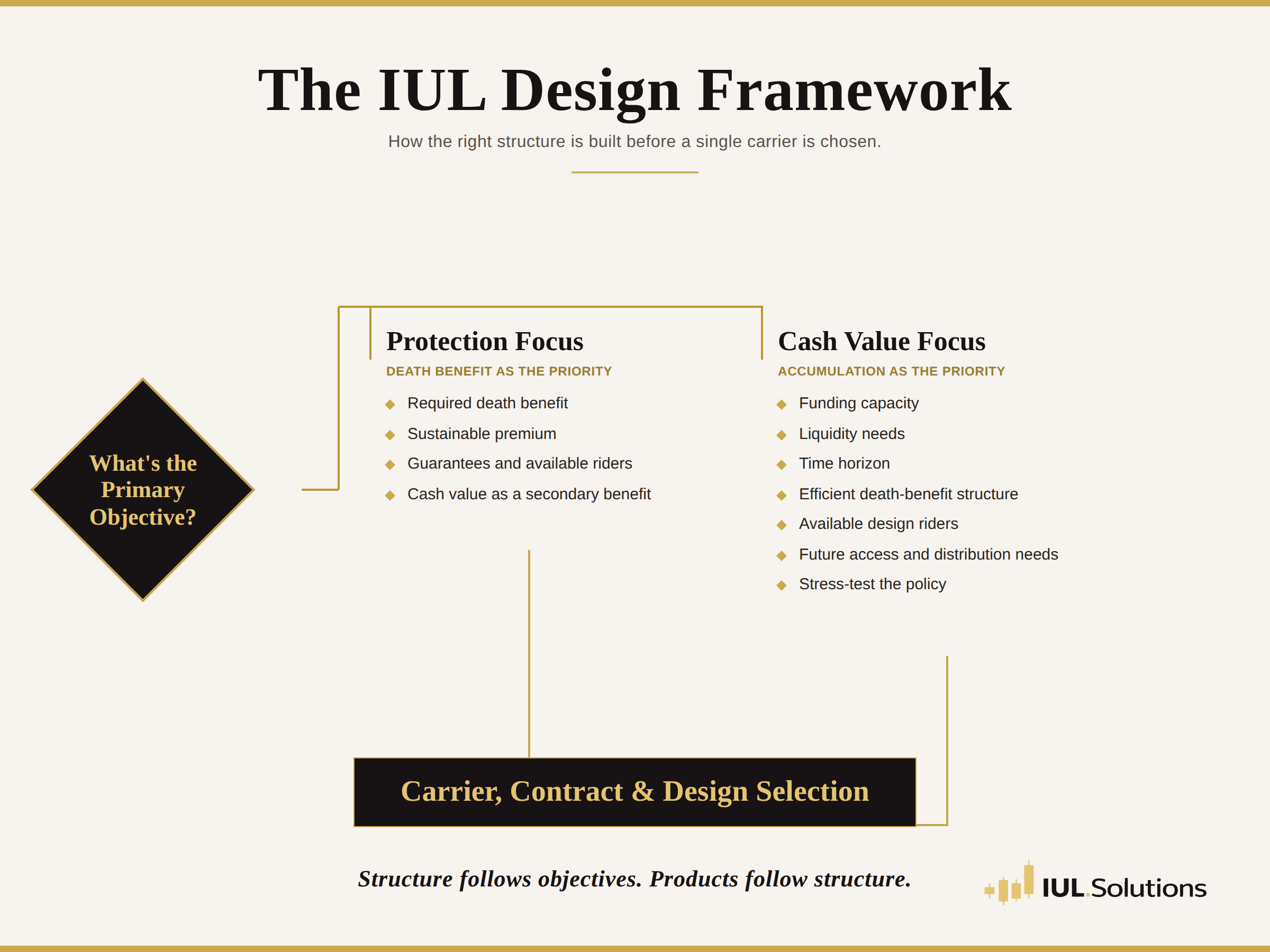
The framework starts with one question: what’s the primary objective?
If it’s protection, design around protection. If it’s accumulation, design around accumulation. Only after we understand the objective and the appropriate structure should we get to carrier, contract, and design selection.
Structure follows objectives. Products follow structure.
Funding Determines More Than the Size of the Cash-Value Column
This is one of the most important parts of an accumulation-focused IUL conversation.
I don’t begin by deciding that someone should put $500, $1,000, or $2,000 a month into a policy. I want to understand where the premium is actually going to come from.
What are you already saving each month? What liquid assets are available? Which assets may appropriately be repositioned toward a long-term objective? What needs to remain liquid and accessible? Are we redirecting dollars already intended for long-term savings, or are we creating a new obligation the household may struggle to maintain?
That’s the thinking behind the funding analysis I use with every client. The objective isn’t to stuff as much money as possible into an insurance contract. It’s to identify an amount that makes sense in the context of the client’s overall resources and objective.
And funding affects much more than the projected accumulation number on an illustration. Funding is also a design decision.
A better-funded IUL has the opportunity to build more cash value, and that cash value matters to the long-term economics of the policy. Depending on the policy’s death-benefit option and structure, as cash value grows it can reduce the net amount at risk, the portion of the death benefit representing the insurance company’s actual insurance exposure.
Why does that matter? Because the cost of insurance generally increases as the insured gets older. A policy with substantial accumulated cash value and a lower net amount at risk can have different long-term cost dynamics than one carrying more pure insurance risk.
More cash value can also provide greater capacity to absorb policy expenses, periods of less favorable index crediting, and the effects of future loans or withdrawals.
So when I talk about funding an IUL appropriately, I’m not simply trying to make the illustrated cash value bigger. I’m thinking about how the policy may behave decades from now. And appropriate funding gives an experienced agent more design options from the very beginning.
The Design Levers Most Consumers Never Hear About
This is where IUL gets much more interesting than comparing which carrier currently has the highest cap.
Depending on the carrier and contract, an agent may have choices involving base death benefit, additional insurance riders, death-benefit options, surrender-charge provisions, and other policy features. Those choices can affect policy expenses, cash-value accumulation, liquidity, and long-term efficiency.
For example, in an accumulation-focused design, the required death benefit may sometimes be constructed using a combination of base coverage and additional insurance available through a rider. Why? Because the way the death benefit is constructed can affect the cost structure of the policy and how efficiently premium dollars can support cash-value accumulation.
The objective isn’t simply to minimize the death benefit. The objective is to provide the appropriate insurance while structuring the contract around what the client is actually trying to accomplish.
Some contracts also provide design options that can reduce or eliminate surrender charges in exchange for different policy economics, potentially making cash value more accessible earlier. That doesn’t turn an IUL into a checking account. It means there are design choices most consumers will never know exist if the entire sales conversation consists of “look at this illustration.”
Larger cases may introduce still more choices. At higher face amounts or premium levels, some carriers offer different contracts, features, or premium economics that may not be available in their basic product designs.
And sometimes the appropriate solution isn’t a conventional single-life IUL at all. A survivorship, or second-to-die, IUL insures two people and generally pays the death benefit after the second insured dies. That can serve an entirely different set of legacy, estate, family, or business objectives.
None of these features automatically makes one policy better than another. They’re design tools. And tools only make sense in relation to the job they’re supposed to perform.
The TikTok Version Leaves Out the Hard Part
If your introduction to IUL came from social media, you’ve probably heard some version of “be your own bank,” “create tax-free retirement income,” or “get market upside without market downside.”
Those phrases can make a complicated insurance contract sound remarkably simple. It isn’t.
I don’t use “be your own bank” as the basis for recommending an IUL. That’s social-media shorthand, not a suitability analysis.
Likewise, life insurance can receive favorable tax treatment when properly structured and managed, but “tax-free retirement” shouldn’t be treated as though there are no rules, limitations, or risks involved. Policy loans and withdrawals have to be managed. Modified Endowment Contract rules matter. The policy’s performance matters. How it was originally designed and funded matters.
Most importantly, none of those slogans tells you whether the policy is appropriately funded, efficiently structured, or prepared for the way the owner eventually intends to use it. That’s the hard part. And it doesn’t fit particularly well into a 30-second video.
A Good Illustration Isn’t Enough
An illustration is useful. It is not a prediction.
If I’m evaluating an accumulation-focused IUL, I don’t want to see only what happens under the primary illustrated assumptions. I want to ask harder questions. What happens if index crediting is less favorable? What happens if the owner takes loans or withdrawals? What happens if funding changes? How much flexibility does the design have? How much of the projected outcome depends on assumptions that may or may not occur? What could put pressure on the policy over time?
A policy intended to last for decades should be examined as though it actually has to survive the real world for decades. That’s why stress testing matters.
And the Work Doesn’t End When the Policy Is Issued
A policy designed today shouldn’t simply disappear into a filing cabinet for the next 25 years.
Actual policy performance should be reviewed against what was originally illustrated. Has funding occurred as planned? How has cash value developed? Have the owner’s objectives changed? Are loans or withdrawals being considered? Does the death-benefit structure still make sense? Are adjustments available or appropriate?
An IUL intended to become a long-term financial asset deserves ongoing policy management, especially if the owner eventually plans to access its cash value. Design matters at the beginning. Management matters afterward. A policy is easier to steward over decades when the person who designed it is still the one reviewing it with you.
Who Probably Isn’t a Good Candidate?
The other side of suitability matters just as much.
Someone shouldn’t buy an IUL simply because they’re afraid of the stock market. They shouldn’t buy one because somebody showed them an enormous projected retirement-income number. They shouldn’t commit money they are likely to need for near-term expenses or emergency reserves.
Someone struggling to meet current obligations probably doesn’t need a new long-term premium commitment simply because they heard about “tax-free income” online. And someone looking for a short-term place to park money needs to understand that permanent life insurance is generally designed around a much longer horizon.
Most importantly, someone shouldn’t buy an IUL they don’t understand. That doesn’t mean becoming an actuary before signing an application. It means understanding what the policy is intended to accomplish, what it costs, what is guaranteed and what isn’t, how it is funded, how cash value may be accessed, and what could affect its long-term performance and durability.
Knowing How to Sell an IUL and Knowing How to Design One Are Not the Same Thing
This may be the most overlooked part of the conversation.
Two people can purchase Indexed Universal Life policies from the same insurance company and end up with very different policies. The carrier matters. The contract matters. Underwriting matters. But design matters too.
Why this death benefit? Why this funding level? Why this rider? Why this death-benefit option? Why this carrier and contract? What alternatives were considered? What happens under less favorable assumptions? How will the policy be reviewed after it’s issued?
Those questions tell you considerably more about an IUL than asking which index strategy produced the highest illustrated number.
I’ve written before about what makes an IUL efficient and why structure matters more than simply choosing an index. I’ve also written about the danger of the “hockey puck” approach to selling IULs, where an illustration becomes a substitute for understanding how the policy was actually designed.
An illustration is a tool. It isn’t the expertise.
So, Who Is an IUL Actually For?
Someone for whom permanent life insurance is appropriate, whose objective fits what the policy can do, who can fund it responsibly, and who understands the policy needs to be designed and managed for the real world, not simply for the illustration.
For some people, that means protection first. For others, long-term cash-value accumulation may be an important part of the objective. And for plenty of people, an IUL won’t be the right tool at all. That’s the point of suitability.
My practice is based in Nashville and serves clients throughout Middle Tennessee as well as in the states where I’m licensed across the country. The approach doesn’t change with geography: understand the objective first, then determine whether an IUL belongs among the solutions worth considering.
Structure follows objectives. Products follow structure.
Kurtz Lytle
About the author. Kurtz Lytle is the founder of IUL.Solutions, an independent insurance and retirement income practice based in Nashville, Tennessee, serving clients throughout Middle Tennessee and nationwide. He works with more than 35 life insurance carriers and designs Indexed Universal Life, annuity, and retirement income strategies built around each client’s objectives rather than a single product. He is licensed in Tennessee (TN964408) and California (4259833), NPN #8993693.
This article is for educational purposes only and does not constitute financial, tax, or legal advice. Indexed Universal Life insurance is a permanent life insurance product; guarantees are subject to the claims-paying ability of the issuing insurance company. Policy loans and withdrawals reduce cash value and death benefit and may have tax consequences, including if the policy is a Modified Endowment Contract or lapses. Illustrated values are not guarantees or projections of future results and depend on the assumptions used. Product features, riders, and availability vary by carrier and state. Any decision to purchase life insurance should be based on your individual circumstances and a review of the actual policy contract. Please consult your own tax or legal advisor regarding your specific situation.